Uno Material
Important
UnoFeatures: Material — add <UnoFeatures>Material</UnoFeatures> to your app's .csproj to add Uno Material.
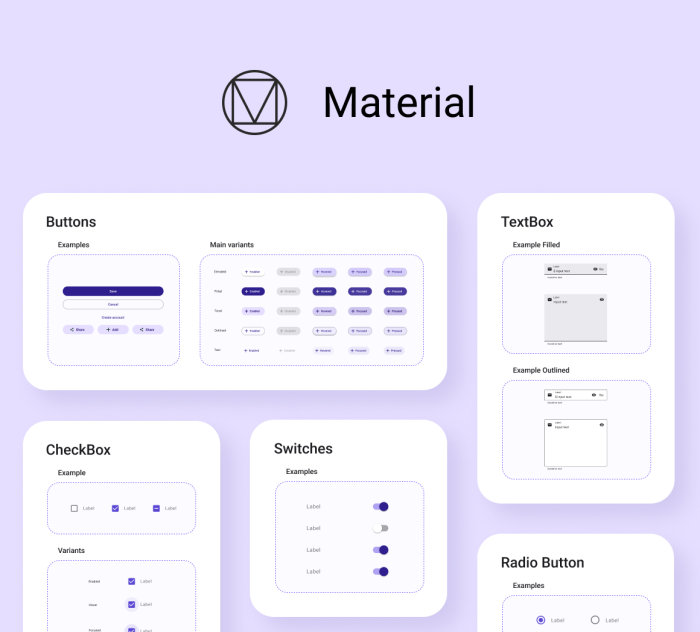
The Uno Material library is enabled through the Material UnoFeatures, which brings in the required packages for new and existing Uno Platform solutions.
Uno Material lets you apply Material Design 3 styling to your application with just a few lines of code.
Warning
If you are updating Uno Material to v2 from an older 1.x version of the package, additional steps will be required. Refer to the Uno Material Migration Guide.
Getting Started
Initialization of the Uno Material resources is handled by the specialized MaterialTheme ResourceDictionary.
MaterialTheme
Constructors
| Constructor | Description |
|---|---|
MaterialTheme() |
Initializes a new instance of the MaterialTheme resource dictionary. |
MaterialTheme(ResourceDictionary? colorOverride, ResourceDictionary? fontOverride) |
Initializes a new instance of the MaterialTheme resource dictionary and applies the given overrides |
Properties
| Property | Type | Description |
|---|---|---|
Colors |
ThemeColors |
(Optional) Groups all color configuration: seed colors (PrimarySeed, …), the generation mode (SeedColorMode), and color overrides. See Seed Color Palette. |
FontOverrideSource |
string |
(Optional) Gets or sets a Uniform Resource Identifier that provides the source location of a ResourceDictionary containing overrides for the default Uno Material font resources |
FontOverrideDictionary |
ResourceDictionary |
(Optional) Gets or sets a ResourceDictionary containing overrides for the default Uno Material font resources, as an inline alternative to FontOverrideSource |
DefaultCornerRadius |
double |
(Optional) Base corner-radius unit driving the shape design tokens. See Design Tokens. |
DefaultSpacing |
double |
(Optional) Base spacing unit (default 8) driving the spacing design tokens; scaled by the DefaultDensity mode. See Design Tokens. |
DefaultDensity |
Density |
(Optional) Density mode (Compact / Regular / Comfy) scaling the spacing base unit by ×0.75 / ×1 / ×1.25. See Design Tokens. |
DefaultFontFamily |
FontFamily |
(Optional) The font the whole type scale is generated from; left unset, Roboto stands. See Change Default Font. |
ColorOverrideSource |
string |
(Deprecated) Use OverrideSource on Colors instead — see the migration notes. |
Creating a new project with Uno Material
Note
Make sure to setup your environment first by following our instructions.
Follow the steps in the Getting Started with Visual Studio instructions to launch the Uno Platform Template Wizard.
Select
Materialunder theThemesection.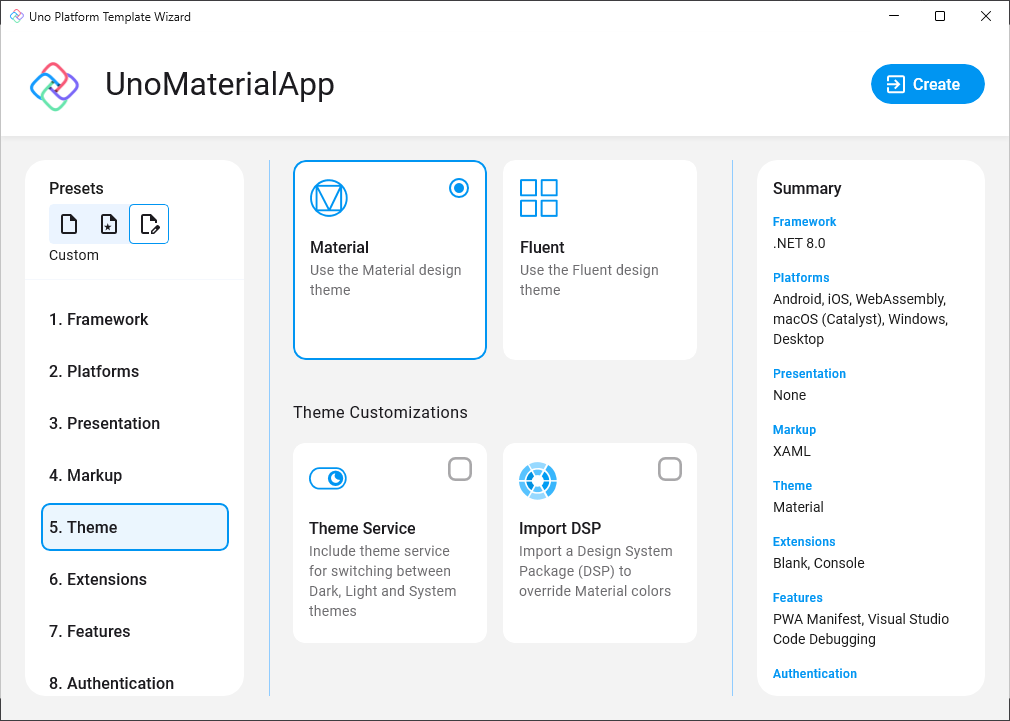
Installing Uno Material in an existing project
Depending on the type of project template that the Uno Platform application was created with, follow the instructions below to install Uno Material.
- Single Project Template
- Multi-Head Project Template (Legacy)
- Shared Project (.shproj) Template (Legacy)
Edit your project file (
PROJECT_NAME.csproj) and addMaterialto the list ofUnoFeatures:<UnoFeatures>Material</UnoFeatures>Initialize
MaterialThemein theApp.xaml:<Application.Resources> <ResourceDictionary> <ResourceDictionary.MergedDictionaries> <!-- Code ommitted of brevity --> <MaterialTheme xmlns="using:Uno.Material" /> </ResourceDictionary.MergedDictionaries> </ResourceDictionary> </Application.Resources>
Customization
Seed Color Palette
The fastest way to a custom color theme: provide a single seed color — typically your brand color — and the library generates the complete Light and Dark palette from it, with readable text contrast built in. No resource dictionaries to write, and the seed can even be changed at runtime. See the Seed Color Palette documentation.
The guides below give you full manual control instead. They require the creation of new ResourceDictionary files in your application project. For more information on how to define styles and resources in a separate ResourceDictionary, refer to the resource management documentation.
Color Overrides using Material Theme Builder and DSP format
It is possible to use the Material Theme Builder to generate a custom color palette derived from your own basic colors. The generated palette is provided in the DSP format and can be used to override the default Uno Material colors.
The tooling required to generate the Material Colors Override file from a theme file (JSON file) will be present by default when creating an Uno Platform application with support for Uno Material from the Wizard.
Follow this link to get more Information about the DSP tooling.
Manual Color Overrides
Use this when you want to manually override the default color palette from the Uno Material library.
Add a new Resource Dictionary named
MaterialColorsOverride.xamlto the application project, for example, underStyles/Application.Replace the content with:
<ResourceDictionary xmlns="http://schemas.microsoft.com/winfx/2006/xaml/presentation"
                    xmlns:x="http://schemas.microsoft.com/winfx/2006/xaml">
    <ResourceDictionary.ThemeDictionaries>

        <!-- Light Theme -->
        <ResourceDictionary x:Key="Light">
            <!-- Primary -->
            <Color x:Key="PrimaryColor">#6750A4</Color>
            <Color x:Key="PrimaryInverseColor">#D0BCFF</Color>
            <Color x:Key="OnPrimaryColor">#FFFFFF</Color>
            <Color x:Key="PrimaryContainerColor">#EADDFF</Color>
            <Color x:Key="OnPrimaryContainerColor">#21005E</Color>

            <!-- Primary Variant Legacy Colors -->
            <Color x:Key="PrimaryVariantDarkColor">#353FE5</Color>
            <Color x:Key="PrimaryVariantLightColor">#B6A8FB</Color>

            <!-- Secondary -->
            <Color x:Key="SecondaryColor">#625B71</Color>
            <Color x:Key="OnSecondaryColor">#FFFFFF</Color>
            <Color x:Key="SecondaryContainerColor">#E5DFF9</Color>
            <Color x:Key="OnSecondaryContainerColor">#1B192C</Color>

            <!-- Secondary Variant Legacy Colors -->
            <Color x:Key="SecondaryVariantDarkColor">#2BB27E</Color>
            <Color x:Key="SecondaryVariantLightColor">#9CFFDF</Color>

            <!-- Tertiary -->
            <Color x:Key="TertiaryColor">#7D5260</Color>
            <Color x:Key="OnTertiaryColor">#FFFFFF</Color>
            <Color x:Key="TertiaryContainerColor">#FFD8E4</Color>
            <Color x:Key="OnTertiaryContainerColor">#370B1E</Color>

            <!-- Error -->
            <Color x:Key="ErrorColor">#B3261E</Color>
            <Color x:Key="OnErrorColor">#FFFFFF</Color>
            <Color x:Key="ErrorContainerColor">#F9DEDC</Color>
            <Color x:Key="OnErrorContainerColor">#370B1E</Color>

            <!-- Background -->
            <Color x:Key="BackgroundColor">#FFFBFE</Color>
            <Color x:Key="OnBackgroundColor">#1C1B1F</Color>

            <!-- Surface -->
            <Color x:Key="SurfaceColor">#FFFBFE</Color>
            <Color x:Key="OnSurfaceColor">#1C1B1F</Color>
            <Color x:Key="SurfaceVariantColor">#E7E0EC</Color>
            <Color x:Key="OnSurfaceVariantColor">#A5A0AC</Color>
            <Color x:Key="SurfaceInverseColor">#313033</Color>
            <Color x:Key="OnSurfaceInverseColor">#F4EFF4</Color>
            <Color x:Key="SurfaceTintColor">#5946D2</Color>

            <!-- Outline -->
            <Color x:Key="OutlineColor">#79747E</Color>
            <Color x:Key="OutlineVariantColor">#C9C5D0</Color>
        </ResourceDictionary>

        <!-- Dark Theme -->
        <ResourceDictionary x:Key="Dark">
            <!-- Primary -->
            <Color x:Key="PrimaryColor">#D0BCFF</Color>
            <Color x:Key="OnPrimaryColor">#371E73</Color>
            <Color x:Key="PrimaryContainerColor">#4F378B</Color>
            <Color x:Key="OnPrimaryContainerColor">#EADDFF</Color>
            <Color x:Key="PrimaryInverseColor">#6750A4</Color>

            <!-- Primary Variant Legacy Colors -->
            <Color x:Key="PrimaryVariantDarkColor">#353FE5</Color>
            <Color x:Key="PrimaryVariantLightColor">#D4CBFC</Color>

            <!-- Secondary -->
            <Color x:Key="SecondaryColor">#CCC2DC</Color>
            <Color x:Key="OnSecondaryColor">#332D41</Color>
            <Color x:Key="SecondaryContainerColor">#474459</Color>
            <Color x:Key="OnSecondaryContainerColor">#E5DFF9</Color>

            <!-- Secondary Variant Legacy Colors -->
            <Color x:Key="SecondaryVariantDarkColor">#2BB27E</Color>
            <Color x:Key="SecondaryVariantLightColor">#9CFFDF</Color>

            <!-- Tertiary -->
            <Color x:Key="TertiaryColor">#EFB8C8</Color>
            <Color x:Key="OnTertiaryColor">#492532</Color>
            <Color x:Key="TertiaryContainerColor">#633B48</Color>
            <Color x:Key="OnTertiaryContainerColor">#FFD8E4</Color>

            <!-- Error -->
            <Color x:Key="ErrorColor">#F2B8B5</Color>
            <Color x:Key="OnErrorColor">#601410</Color>
            <Color x:Key="ErrorContainerColor">#8C1D18</Color>
            <Color x:Key="OnErrorContainerColor">#F9DEDC</Color>

            <!-- Background -->
            <Color x:Key="BackgroundColor">#1C1B1F</Color>
            <Color x:Key="OnBackgroundColor">#E6E1E5</Color>

            <!-- Surface -->
            <Color x:Key="SurfaceColor">#1C1B1F</Color>
            <Color x:Key="OnSurfaceColor">#E6E1E5</Color>
            <Color x:Key="SurfaceVariantColor">#49454F</Color>
            <Color x:Key="OnSurfaceVariantColor">#CAC4D0</Color>
            <Color x:Key="SurfaceInverseColor">#E6E1E5</Color>
            <Color x:Key="OnSurfaceInverseColor">#313033</Color>
            <Color x:Key="SurfaceTintColor">#C7BFFF</Color>

            <!-- Outline -->
            <Color x:Key="OutlineColor">#938F99</Color>
            <Color x:Key="OutlineVariantColor">#57545D</Color>
        </ResourceDictionary>

    </ResourceDictionary.ThemeDictionaries>
</ResourceDictionary>
In
App.xaml, update<MaterialTheme />with the override from the previous steps:<MaterialTheme xmlns="using:Uno.Material" ColorOverrideSource="ms-appx:///Styles/Application/MaterialColorsOverride.xaml" />
Change Default Font
By default, Uno Material comes pre-packaged with the Roboto font family and automatically includes it in your application. Every type scale derives from the single DefaultFontFamily root token; per-scale weight nuance comes from the *FontWeight tokens, resolved from that one family reference.
If you would like Uno Material to use a different font:
Add the custom font following Custom Fonts documentation. Prefer a family that resolves multiple weights (a variable font, or a font shipping a font manifest) so the
*FontWeighttokens render as designed.In
App.xaml, set theDefaultFontFamilyproperty on the theme:<MaterialTheme xmlns="using:Uno.Material" DefaultFontFamily="ms-appx:///Assets/Fonts/MyCustomFont.ttf#MyCustomFont" />
That one value regenerates the DefaultFontFamily root token and every type-scale *FontFamily key derived from it, and it can also be changed at runtime — see Typography Font Swap.
To change only some appearances or some scales instead, provide a font override dictionary:
Add a Resource Dictionary named
MaterialFontsOverride.xamlto the application project, for example underStyles/Application, and redefine the individual*FontFamilytoken(s) in it:<ResourceDictionary xmlns="http://schemas.microsoft.com/winfx/2006/xaml/presentation" xmlns:x="http://schemas.microsoft.com/winfx/2006/xaml"> <FontFamily x:Key="DisplayLargeFontFamily">ms-appx:///Assets/Fonts/MyCustomFont.ttf#MyCustomFont</FontFamily> <FontFamily x:Key="DisplayMediumFontFamily">ms-appx:///Assets/Fonts/MyCustomFont.ttf#MyCustomFont</FontFamily> </ResourceDictionary>In
App.xaml, reference it from the theme:<MaterialTheme xmlns="using:Uno.Material" FontOverrideSource="ms-appx:///Styles/Application/MaterialFontsOverride.xaml" />
A key declared in the override wins over the generated one — see Typography Font Swap.
Important
Overriding the legacy MaterialLightFontFamily / MaterialMediumFontFamily / MaterialRegularFontFamily keys no longer changes the type scales — see the migration notes.
Using C# Markup
Uno Material also has support for C# Markup through a Uno.Material.WinUI.Markup NuGet Package.
To get started with Uno Material in your C# Markup application, add the Uno.Material.WinUI.Markup NuGet package to your application project.
Then, add the following code to your App.xaml.cs:
using Uno.Material.Markup;

this.Build(r => r.UseMaterial(
     //optional
     new Styles.ColorPaletteOverride(),
     //optional
     new Styles.MaterialFontsOverride()));